A Difference in ________ Can Explain Why One Person Dies From a Disease and Another Person Survives
Section ii: Morbidity Frequency Measures
Morbidity has been divers as any departure, subjective or objective, from a state of physiological or psychological well-existence. In exercise, morbidity encompasses affliction, injury, and inability. In addition, although for this lesson the term refers to the number of persons who are ill, it tin also exist used to draw the periods of illness that these persons experienced, or the duration of these illnesses.(4)
Measures of morbidity frequency characterize the number of persons in a population who become sick (incidence) or are sick at a given time (prevalence). Commonly used measures are listed in Table 3.iii.
Tabular array 3.iii Frequently Used Measures of Morbidity
| Measure | Numerator | Denominator |
|---|---|---|
| Incidence proportion | Number of new cases of disease during specified time interval | Population at start of fourth dimension interval |
| Secondary attack rate | Number of new cases among contacts | Total number of contacts |
| Incidence rate | Number of new cases of disease during specified time interval | Summed person-years of observation or average population during time interval |
| Betoken prevalence | Number of electric current cases (new and preexisting) at a specified bespeak in time | Population at the same specified point in time |
| Menstruation prevalence | Number of current cases (new and preexisting) over a specified catamenia of time | Average or mid-interval population |
Incidence refers to the occurrence of new cases of illness or injury in a population over a specified catamenia of time. Although some epidemiologists employ incidence to hateful the number of new cases in a community, others use incidence to hateful the number of new cases per unit of population.
Two types of incidence are commonly used — incidence proportion and incidence rate.
Incidence proportion or take a chance
Definition of incidence proportion
Synonyms for incidence proportion
- Attack rate
- Risk
- Probability of developing disease
- Cumulative incidence
Incidence proportion is the proportion of an initially disease-gratis population that develops disease, becomes injured, or dies during a specified (normally limited) menstruum of time. Synonyms include attack rate, chance, probability of getting illness, and cumulative incidence. Incidence proportion is a proportion because the persons in the numerator, those who develop illness, are all included in the denominator (the entire population).
Method for computing incidence proportion (risk)
Number of new cases of illness or injury during
specified period  Size of population at outset of period
EXAMPLES: Calculating Incidence Proportion (Risk)
Example A: In the written report of diabetics, 100 of the 189 diabetic men died during the 13-year follow-up period. Summate the risk of death for these men.
Numerator = 100 deaths amongst the diabetic men
Denominator = 189 diabetic men
tenn = 102 = 100
Risk = (100 ⁄ 189) × 100 = 52.9%
Example B: In an outbreak of gastroenteritis among attendees of a corporate picnic, 99 persons ate spud salad, 30 of whom developed gastroenteritis. Calculate the risk of illness amid persons who ate potato salad.
Numerator = thirty persons who ate irish potato salad and adult gastroenteritis
Denominator = 99 persons who ate potato salad
tennorthward = 102 = 100
Gamble = "Food-specific assail charge per unit" = (30 ⁄ 99) × 100 = 0.303 × 100 = xxx.iii%
Properties and uses of incidence proportions
- Incidence proportion is a measure of the chance of affliction or the probability of developing the disease during the specified menses. Equally a measure of incidence, information technology includes simply new cases of affliction in the numerator. The denominator is the number of persons in the population at the start of the ascertainment flow. Because all of the persons with new cases of disease (numerator) are also represented in the denominator, a adventure is too a proportion.
More Well-nigh Denominators
The denominator of an incidence proportion is the number of persons at the beginning of the observation menses. The denominator should be express to the "population at risk" for developing illness, i.e., persons who have the potential to get the disease and exist included in the numerator. For example, if the numerator represents new cases of cancer of the ovaries, the denominator should be restricted to women, considering men practise not have ovaries. This is easily accomplished because census data by sex activity are readily available. In fact, ideally the denominator should be restricted to women with ovaries, excluding women who accept had their ovaries removed surgically (often done in conjunction with a hysterectomy), just this is not usually practical. This is an example of field epidemiologists doing the best they can with the data they have.
- In the outbreak setting, the term attack rate is ofttimes used every bit a synonym for risk. Information technology is the run a risk of getting the disease during a specified period, such as the duration of an outbreak. A variety of attack rates can be calculated.
Overall attack rate is the full number of new cases divided by the full population.
A nutrient-specific attack rate is the number of persons who ate a specified food and became sick divided by the total number of persons who ate that food, as illustrated in the previous spud salad example.
A secondary attack rate is sometimes calculated to document the departure between community transmission of illness versus manual of illness in a household, barracks, or other airtight population. It is calculated equally:
Number of cases amid contacts of principal cases
Full number of contacts× 10 northward
Frequently, the full number of contacts in the denominator is calculated every bit the total population in the households of the primary cases, minus the number of chief cases. For a secondary assault rate, 10n usually is 100%.
Example: Calculating Secondary Set on Rates
Consider an outbreak of shigellosis in which 18 persons in 18 different households all became ill. If the population of the community was 1,000, then the overall attack rate was eighteen ⁄ ane,000 × 100% = i.8%. 1 incubation period subsequently, 17 persons in the same households as these "principal" cases developed shigellosis. If the 18 households included 86 persons, calculate the secondary attack rate.
Secondary attack rate = (17 ⁄ (86 − eighteen)) × 100% = (17 ⁄ 68) × 100% = 25.0%
Incidence rate or person-fourth dimension charge per unit
Definition of incidence rate
Incidence rate or person-time rate is a measure of incidence that incorporates time directly into the denominator. A person-time rate is generally calculated from a long-term cohort follow-up report, wherein enrollees are followed over time and the occurrence of new cases of disease is documented. Typically, each person is observed from an established starting time until one of four "end points" is reached: onset of illness, death, migration out of the written report ("lost to follow-upwardly"), or the end of the study. Similar to the incidence proportion, the numerator of the incidence rate is the number of new cases identified during the period of ascertainment. However, the denominator differs. The denominator is the sum of the fourth dimension each person was observed, totaled for all persons. This denominator represents the total time the population was at risk of and existence watched for affliction. Thus, the incidence rate is the ratio of the number of cases to the full time the population is at risk of disease.
Method for calculating incidence charge per unit
Number of new cases of disease or injury during specified period Time each person was observed, totaled for all persons
In a long-term follow-upwards study of morbidity, each written report participant may be followed or observed for several years. 1 person followed for 5 years without developing disease is said to contribute 5 person-years of follow-up.
What nearly a person followed for one yr before being lost to follow-up at year two? Many researchers assume that persons lost to follow-up were, on average, disease-free for half the year, and thus contribute ½ twelvemonth to the denominator. Therefore, the person followed for 1 year before being lost to follow-up contributes 1.5 person-years. The same assumption is made for participants diagnosed with the disease at the twelvemonth 2 test — some may have adult illness in calendar month 1, and others in months ii through 12. So, on average, they developed disease halfway through the twelvemonth. Every bit a event, persons diagnosed with the illness contribute ½ year of follow-up during the year of diagnosis.
The denominator of the person-time rate is the sum of all of the person-years for each written report participant. So, someone lost to follow-up in year 3, and someone diagnosed with the disease in year 3, each contributes 2.v years of disease-gratis follow-up to the denominator.
Properties and uses of incidence rates
- An incidence charge per unit describes how quickly affliction occurs in a population. It is based on person-time, so information technology has some advantages over an incidence proportion. Considering person-time is calculated for each subject, it tin accommodate persons coming into and leaving the study. Equally noted in the previous case, the denominator accounts for study participants who are lost to follow-up or who die during the study catamenia. In addition, it allows enrollees to enter the study at different times. In the NHANES follow-upwardly study, some participants were enrolled in 1971, others in 1972, 1973, 1974, and 1975.
- Person-time has one important drawback. Person-time assumes that the probability of illness during the written report flow is constant, and so that 10 persons followed for i year equals one person followed for 10 years. Considering the hazard of many chronic diseases increases with age, this assumption is frequently not valid.
- Long-term cohort studies of the type described hither are not very common. Still, epidemiologists far more commonly calculate incidence rates based on a numerator of cases observed or reported, and a denominator based on the mid-year population. This blazon of incident charge per unit turns out to be comparable to a person-time rate.
- Finally, if you study the incidence rate of, say, the centre disease study as ii.5 per one,000 person-years, epidemiologists might sympathise, but most others will not. Person-time is epidemiologic jargon. To convert this jargon to something understandable, simply replace "person-years" with "persons per year." Reporting the results as 2.5 new cases of heart affliction per 1,000 persons per twelvemonth sounds like English rather than jargon. It as well conveys the sense of the incidence rate as a dynamic procedure, the speed at which new cases of disease occur in the population.
EXAMPLES: Calculating Incidence Rates
Example A: Investigators enrolled 2,100 women in a study and followed them annually for four years to decide the incidence rate of heart disease. Afterward one year, none had a new diagnosis of centre disease, merely 100 had been lost to follow-up. Subsequently two years, ane had a new diagnosis of eye disease, and another 99 had been lost to follow-up. Later iii years, another seven had new diagnoses of heart disease, and 793 had been lost to follow-up. Later on iv years, another 8 had new diagnoses with heart disease, and 392 more than had been lost to follow-upwards.
The study results could likewise be described equally follows: No heart affliction was diagnosed at the first year. Heart disease was diagnosed in i woman at the second year, in seven women at the third yr, and in 8 women at the fourth year of follow-upwardly. I hundred women were lost to follow-up past the first year, some other 99 were lost to follow-up after ii years, another 793 were lost to follow-up after three years, and another 392 women were lost to follow-upwards after iv years, leaving 700 women who were followed for 4 years and remained disease free.
Calculate the incidence rate of eye disease amidst this cohort. Assume that persons with new diagnoses of heart disease and those lost to follow-up were disease-free for half the year, and thus contribute ½ year to the denominator.
Numerator = number of new cases of heart disease
= 0 + 1 + 7 + 8 = 16
Denominator = person-years of observation
= (2,000 + ½ × 100) + (1,900 + ½ × ane + ½ × 99) + (ane,100 + ½ × 7 + ½ × 793) +
(700 + ½ × viii + ½ × 392)
= 6,400 person-years of follow-up
or
Denominator = person-years of observation
= (1 × one.five) + (7 × 2.5) + (viii × iii.five) + (100 × 0.v) + (99 × 1.5) + (793 × 2.5) +
(392 × 3.5) + (700 × 4)
= 6,400 person-years of follow-upwardly
Person-time rate =
Number of new cases of affliction or injury during specified menses Fourth dimension each person was observed, totaled for all persons
= 16 ⁄ six,400
= .0025 cases per person-twelvemonth
= 2.5 cases per 1,000 person-years
In dissimilarity, the incidence proportion can be calculated equally sixteen ⁄ 2,100 = 7.6 cases per 1,000 population during the iv-year period, or an boilerplate of 1.nine cases per 1,000 per year (7.vi divided by 4 years). The incidence proportion underestimates the truthful charge per unit because it ignores persons lost to follow-upward, and assumes that they remained disease-free for all four years.
Example B: The diabetes follow-upward study included 218 diabetic women and iii,823 nondiabetic women. Past the end of the study, 72 of the diabetic women and 511 of the nondiabetic women had died. The diabetic women were observed for a total of i,862 person years; the nondiabetic women were observed for a total of 36,653 person years. Summate the incidence rates of expiry for the diabetic and not-diabetic women.
For diabetic women, numerator = 72 and denominator = i,862
Person-time rate = 72 ⁄ one,862
= 0.0386 deaths per person-year
= 38.six deaths per ane,000 person-years
For nondiabetic women, numerator = 511 and denominator = 36,653
Person-time rate = 511 ⁄ 36,653 = 0.0139 deaths per person-year
= 13.9 deaths per 1,000 person-years
EXAMPLES: Calculating Incidence Rates (Continued)
Case C: In 2003, 44,232 new cases of acquired immunodeficiency syndrome (AIDS) were reported in the Usa.(v) The estimated mid-year population of the U.S. in 2003 was approximately 290,809,777.(6) Calculate the incidence rate of AIDS in 2003.
Numerator = 44,232 new cases of AIDS
Denominator = 290,809,777 estimated mid-year population
tendue north = 100,000
Incidence charge per unit = (44,232 ⁄ 290,809,777) × 100,000
= 15.21 new cases of AIDS per 100,000 population
Prevalence
Definition of prevalence
Prevalence, sometimes referred to every bit prevalence rate, is the proportion of persons in a population who have a detail disease or attribute at a specified point in time or over a specified menstruum of time. Prevalence differs from incidence in that prevalence includes all cases, both new and preexisting, in the population at the specified time, whereas incidence is limited to new cases simply.
Indicate prevalence refers to the prevalence measured at a particular point in time. It is the proportion of persons with a particular affliction or attribute on a particular engagement.
Menstruum prevalence refers to prevalence measured over an interval of time. It is the proportion of persons with a particular affliction or aspect at any time during the interval.
Method for calculating prevalence of disease
All new and pre-existing cases
during a given time period Population during the same time menstruation
× 10 n
Method for calculating prevalence of an attribute
Persons having a particular attribute
during a given time period Population during the aforementioned fourth dimension menstruation
× 10 n
The value of ten due north is usually ane or 100 for common attributes. The value of 10 n might exist ane,000, 100,000, or fifty-fifty 1,000,000 for rare attributes and for most diseases.
EXAMPLE: Computing Prevalence
In a survey of one,150 women who gave birth in Maine in 2000, a full of 468 reported taking a multivitamin at least 4 times a calendar week during the calendar month before becoming pregnant.(vii) Summate the prevalence of frequent multivitamin use in this grouping.
Numerator = 468 multivitamin users
Denominator = one,150 women
Prevalence = (468 ⁄ 1,150) × 100 = 0.407 × 100 = 40.7%
Properties and uses of prevalence
- Prevalence and incidence are frequently confused. Prevalence refers to proportion of persons who have a status at or during a item time catamenia, whereas incidence refers to the proportion or charge per unit of persons who develop a condition during a particular time menstruation. Then prevalence and incidence are similar, simply prevalence includes new and pre-existing cases whereas incidence includes new cases only. The primal deviation is in their numerators.
Numerator of incidence = new cases that occurred during a given time period
Numerator of prevalence = all cases present during a given time period
- The numerator of an incidence proportion or charge per unit consists just of persons whose affliction began during the specified interval. The numerator for prevalence includes all persons ill from a specified cause during the specified interval regardless of when the illness began. It includes non only new cases, but also preexisting cases representing persons who remained ill during some portion of the specified interval.
- Prevalence is based on both incidence and duration of illness. High prevalence of a affliction within a population might reflect loftier incidence or prolonged survival without cure or both. Conversely, depression prevalence might betoken low incidence, a rapidly fatal procedure, or rapid recovery.
- Prevalence rather than incidence is frequently measured for chronic diseases such as diabetes or osteoarthritis which have long duration and dates of onset that are difficult to pinpoint.
EXAMPLES: Incidence versus Prevalence
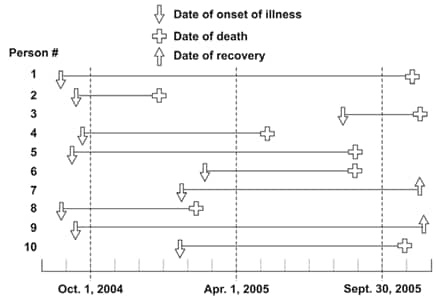
Figure 3.1 represents 10 new cases of illness over about fifteen months in a population of 20 persons. Each horizontal line represents one person. The down pointer indicates the date of onset of illness. The solid line represents the duration of illness. The up arrow and the cantankerous represent the date of recovery and date of expiry, respectively.
Figure three.one New Cases of Illness from October 1, 2004–September thirty, 2005
Prototype Description
Example A: Calculate the incidence rate from October 1, 2004, to September xxx, 2005, using the midpoint population (population alive on April 1, 2005) as the denominator. Express the charge per unit per 100 population.
Incidence rate numerator = number of new cases between October 1 and September xxx
= 4 (the other half-dozen all had onsets before October 1, and are not included)
Incidence rate denominator = April 1 population
= 18 (persons 2 and 8 died before Apr 1)
Incidence rate = (4 ⁄ xviii) × 100
= 22 new cases per 100 population
Instance B: Calculate the indicate prevalence on Apr ane, 2005. Betoken prevalence is the number of persons ill on the engagement divided by the population on that date. On Apr ane, seven persons (persons 1, 4, 5, seven, ix, and 10) were ill.
Point prevalence = (7 ⁄ 18) × 100
= 38.89%
Example C: Calculate the period prevalence from Oct ane, 2004, to September 30, 2005. The numerator of menses prevalence includes anyone who was ill whatsoever fourth dimension during the period. In Figure 3.1, the first 10 persons were all sick at some time during the flow.
Menstruum prevalence = (10 ⁄ 20) × 100
= l.0%
 Do 3.2
For each of the fractions shown below, indicate whether information technology is an incidence proportion, incidence rate, prevalence, or none of the three.
- Incidence proportion
- Incidence rate
- Prevalence
- None of the above
- ____ i.
number of women in Framingham Study
who have died through last year from center illnessnumber of women initially enrolled in Framingham Study - ____ 2.
number of women in Framingham Report who have died
through final year from heart diseasenumber of person-years contributed through last year past
women initially enrolled in Framingham Study - ____ iii.
number of women in boondocks of Framingham who reported having center disease in recent health survey
estimated number of women residents of Framingham during aforementioned flow - ____ 4.
number of women in Framingham Study newly diagnosed with middle disease last year
number of women in Framingham Report without heart illness
at beginning of same year - ____ 5.
number of women in Country A newly diagnosed with heart illness in 2004
estimated number of women living in State A on July i, 2004 - ____ 6.
estimated number of women smokers in State A according to 2004 Behavioral Risk Factor Survey
estimated number of women living in State A on July i, 2004 - ____ 7.
number of women in State A who reported center disease in 2004 health survey
estimated number of women smokers in State A according 2004 Behavioral Run a risk Gene Survey
Check your answer.
References (This Section)
- Last JM. A dictionary of epidemiology, 4th ed. New York: Oxford U. Printing; 2001.
- Hopkins RS, Jajosky RA, Hall PA, Adams DA, Connor FJ, Precipitous P, et. al. Summary of notifiable diseases — United States, 2003. MMWR 2003;52(No 54):one–85.
- U.Due south. Census Bureau [Internet]. Washington, DC: [updated 11 Jul 2006; cited 2005 Oct ii]. Population Estimates. Available from: http://world wide web.census.gov/popestexternal icon.
- Williams LM, Morrow B, Lansky A. Surveillance for selected maternal behaviors and experiences before, during, and after pregnancy: Pregnancy Risk Cess Monitoring System (PRAMS). In: Surveillance Summaries, November 14, 2003. MMWR 2003;52(No. SS-11):i–14.
Figure 3.ane
Description: Earlier October 1, six people became ill; 2 of them died before April ane. Between October ane and September 30, 4 more than persons became ill. 6 more persons died afterwards April one. Return to text.
Source: https://www.cdc.gov/csels/dsepd/ss1978/lesson3/section2.html
0 Response to "A Difference in ________ Can Explain Why One Person Dies From a Disease and Another Person Survives"
Postar um comentário